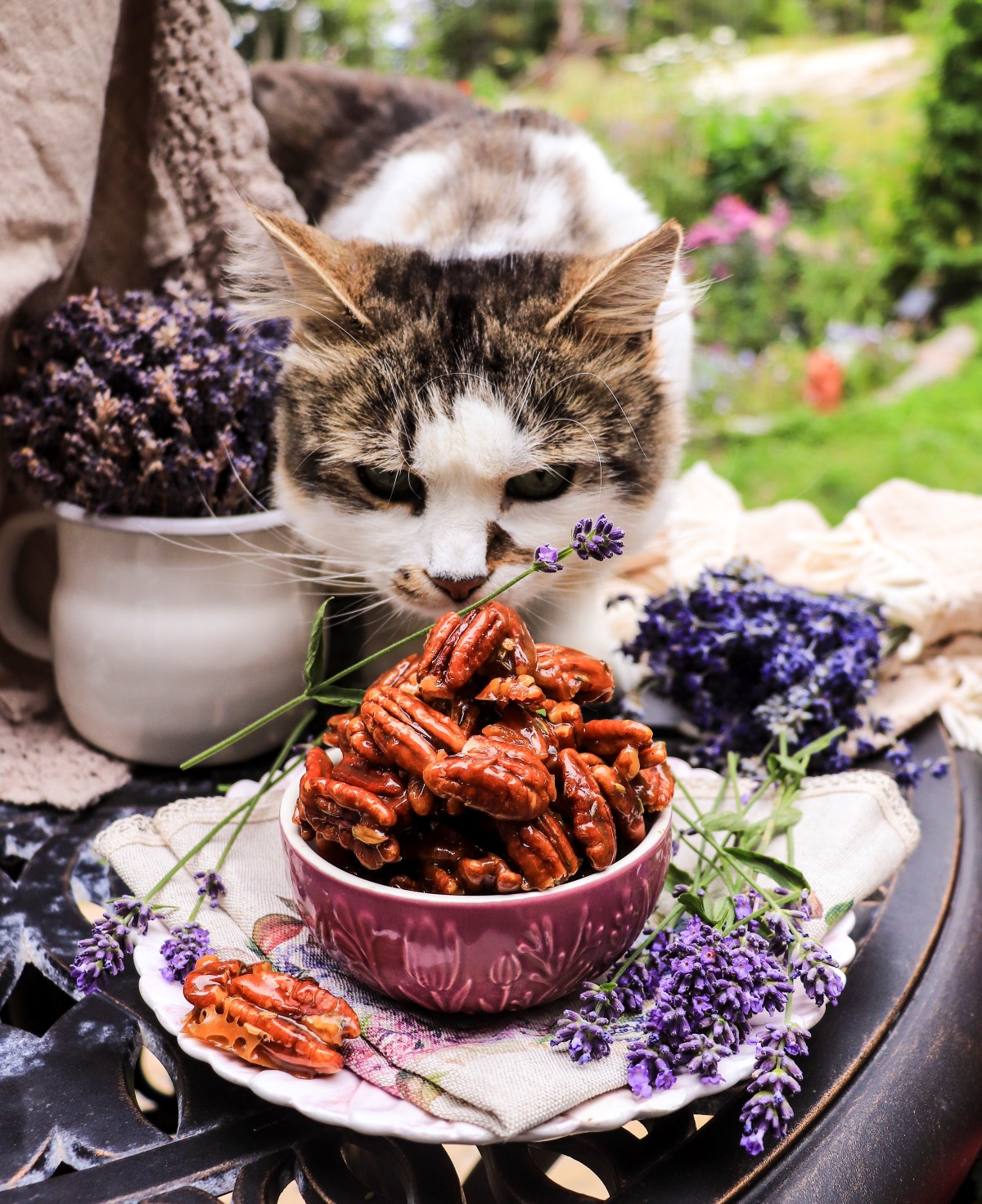
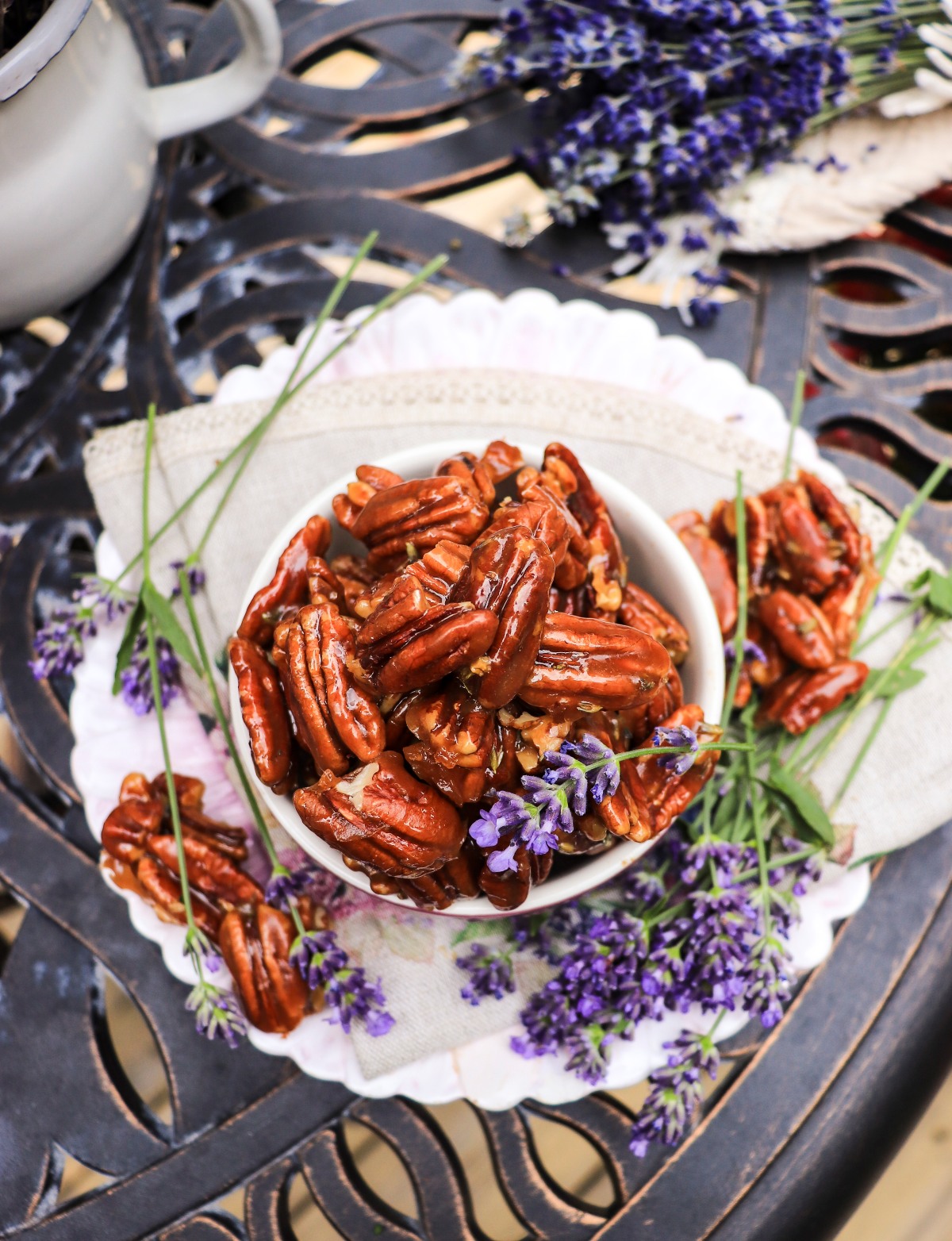
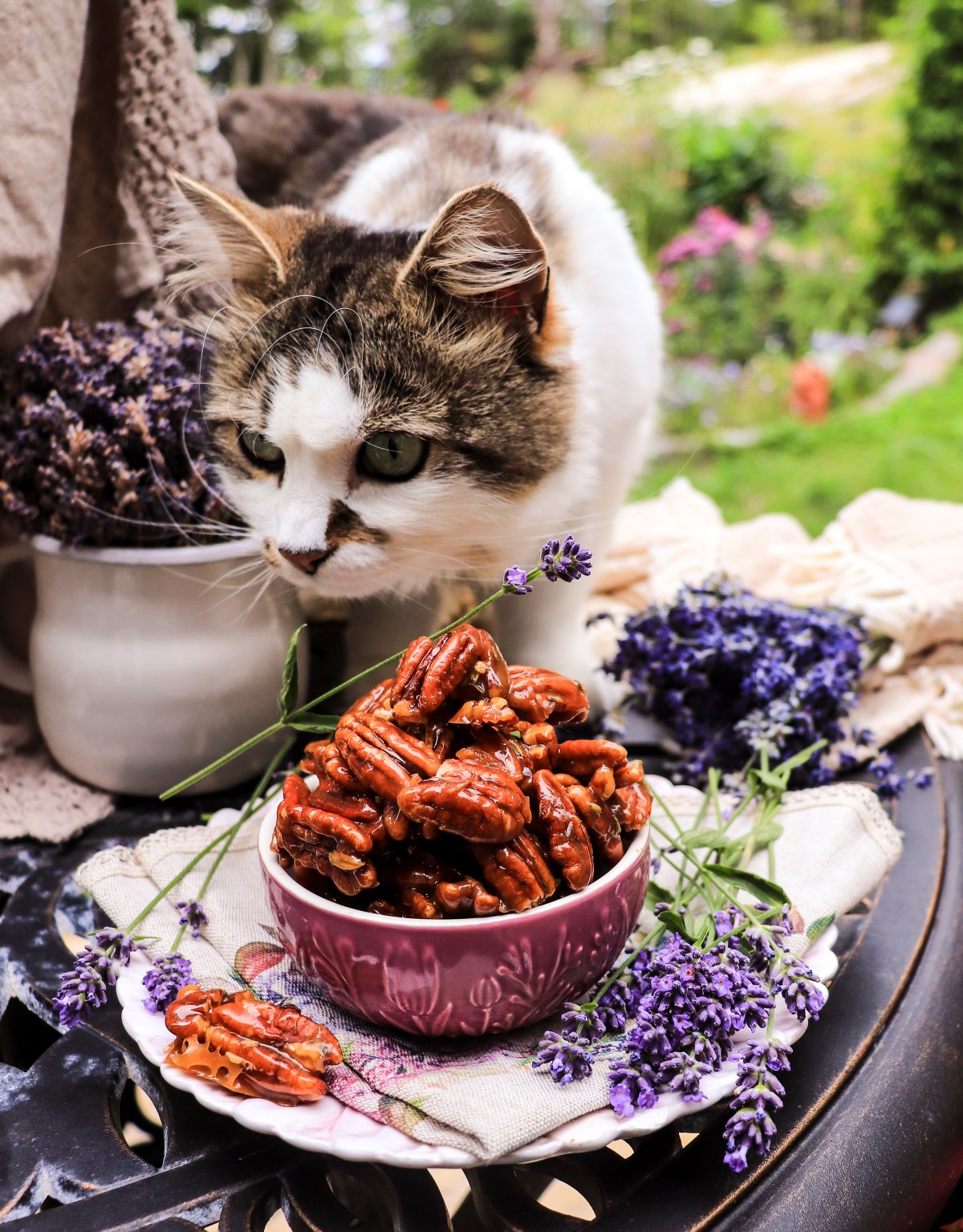
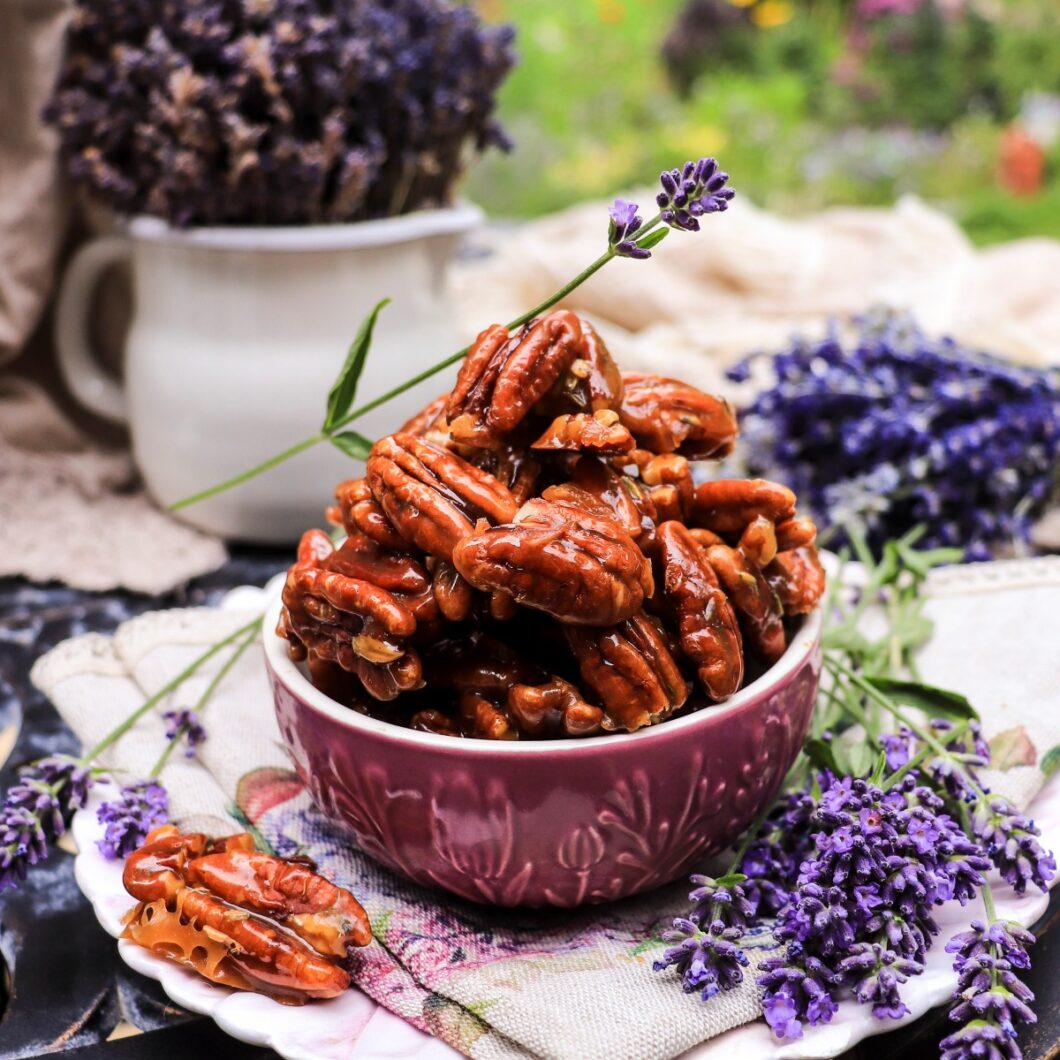
These honey caramelized pecans with lavender are buttery, crunchy, and coated in a rich honey glaze with a subtle floral aroma. Made entirely in a skillet, these stovetop candied pecans are an easy alternative to traditional oven-baked candied nuts.
Hey folks – I hope you all are doing well!
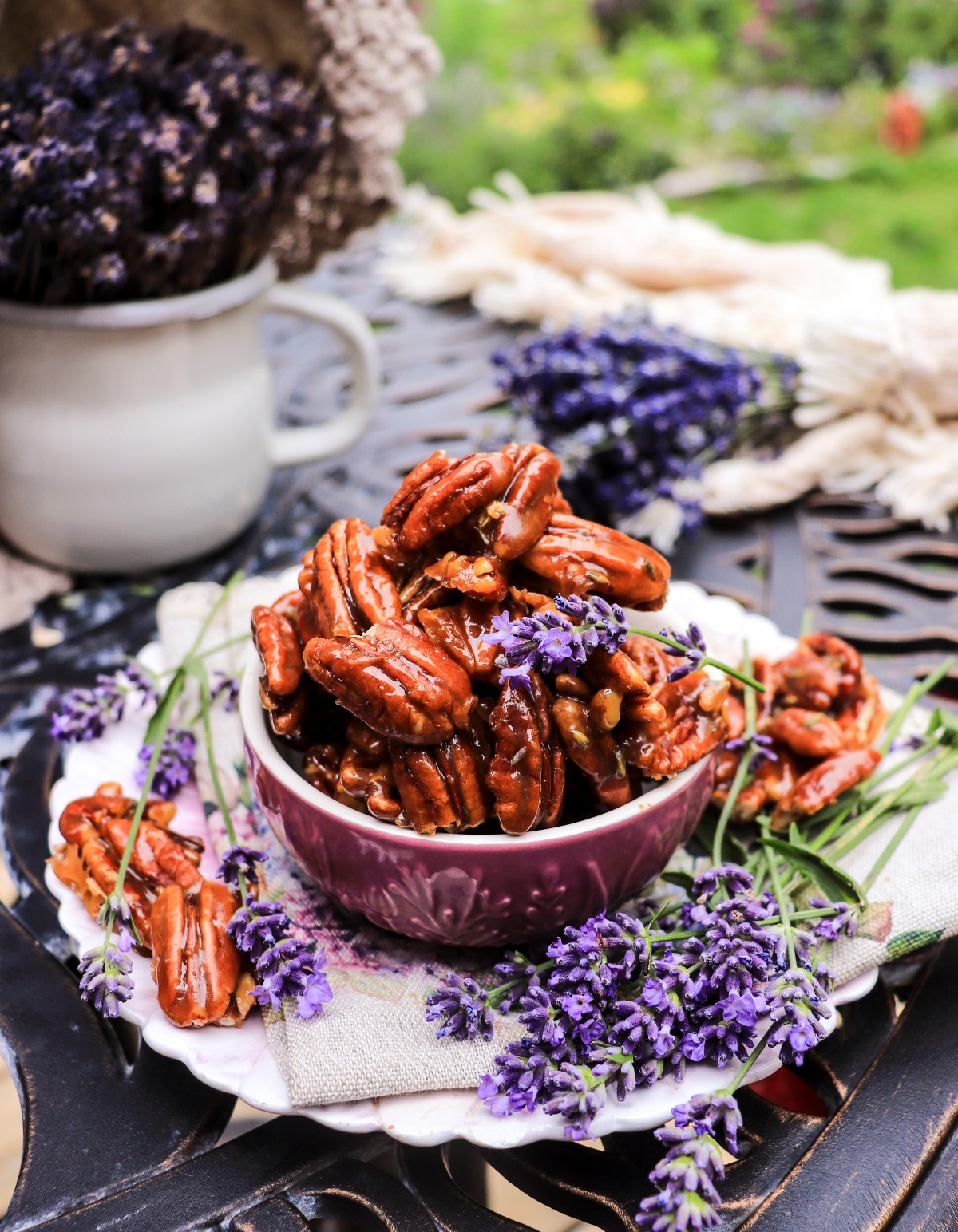
If you love homemade candied pecans but don’t necessarily want to turn on the oven, this recipe is for you. These honey candied pecans come together quickly on the stovetop, starting with a brief toasting and finishing with a buttery honey and sugar coating.
And then there is lavender! Honey and lavender are a beautiful pairing, and you only need a tiny amount here. The result isn’t overwhelmingly floral. Instead, lavender accentuates the natural floral notes of honey while complementing the rich, toasted pecans. So, let’s dive into this recipe for caramelized pecans with honey and lavender!
What Are Caramelized Nuts?
Caramelized nuts are nuts coated in a sweet mixture that is cooked until it thickens and clings to their surface. Depending on the recipe and technique, the coating can range from thin, glossy, and slightly sticky to dry, crisp, and crystallized.
There isn’t just one way to make caramelized nuts, either. Some recipes rely primarily on granulated sugar and water, while others incorporate butter, honey, maple syrup, spices, or egg whites. Likewise, both oven and stovetop methods are common, and the cooking method influences the final texture.
Caramelized, Candied, Sugared, or Frosted Nuts?
You have probably seen all these terms used for sweet-coated nuts. There is considerable overlap, and terminology isn’t always consistent. However, there are some general distinctions.
- Caramelized nuts are coated with sugar or another sweetener that is cooked into a caramel-like mixture. Depending on the recipe, the coating may be glossy, crisp, or slightly sticky.
- Candied nuts are a broader category that includes many nuts prepared with a cooked sweet coating. Therefore, caramelized pecans can generally be considered a type of candied pecan.
- Sugared nuts usually have a noticeable granular sugar coating rather than a smooth glaze.
- Frosted nuts generally have a dry, opaque, crystallized coating. In this case, crystallization is desirable rather than something the cook tries to prevent.
- Glazed nuts usually have a relatively smooth and shiny coating. Liquid sweeteners such as honey and maple syrup work particularly well for this type of finish.
These stovetop honey caramelized pecans with lavender fall somewhere between caramelized and glazed pecans. At the same time, honey candied pecans is a perfectly reasonable broader description because the nuts are cooked in a sweet coating.
Traditional Oven-Baked vs. Stovetop Candied Nuts
Many traditional candied nut recipes use an oven. The pecans or other nuts are tossed with a sugar mixture and baked, sometimes with occasional stirring. This gradual cooking method works particularly well when you want a relatively dry, crisp coating.
Stovetop candied nuts use a different approach. Instead of slowly baking the coating onto the nuts, you cook the syrup directly in a skillet and then coat the nuts with it. The process is considerably faster and gives you direct control over how quickly the syrup thickens.
For these stovetop honey and lavender candied pecans, the skillet method makes particular sense because honey, butter, and sugar create a glossy coating quickly. There is no need for a lengthy baking process to achieve a rich caramelized finish.
What Makes These Honey Lavender Caramelized Pecans Special?
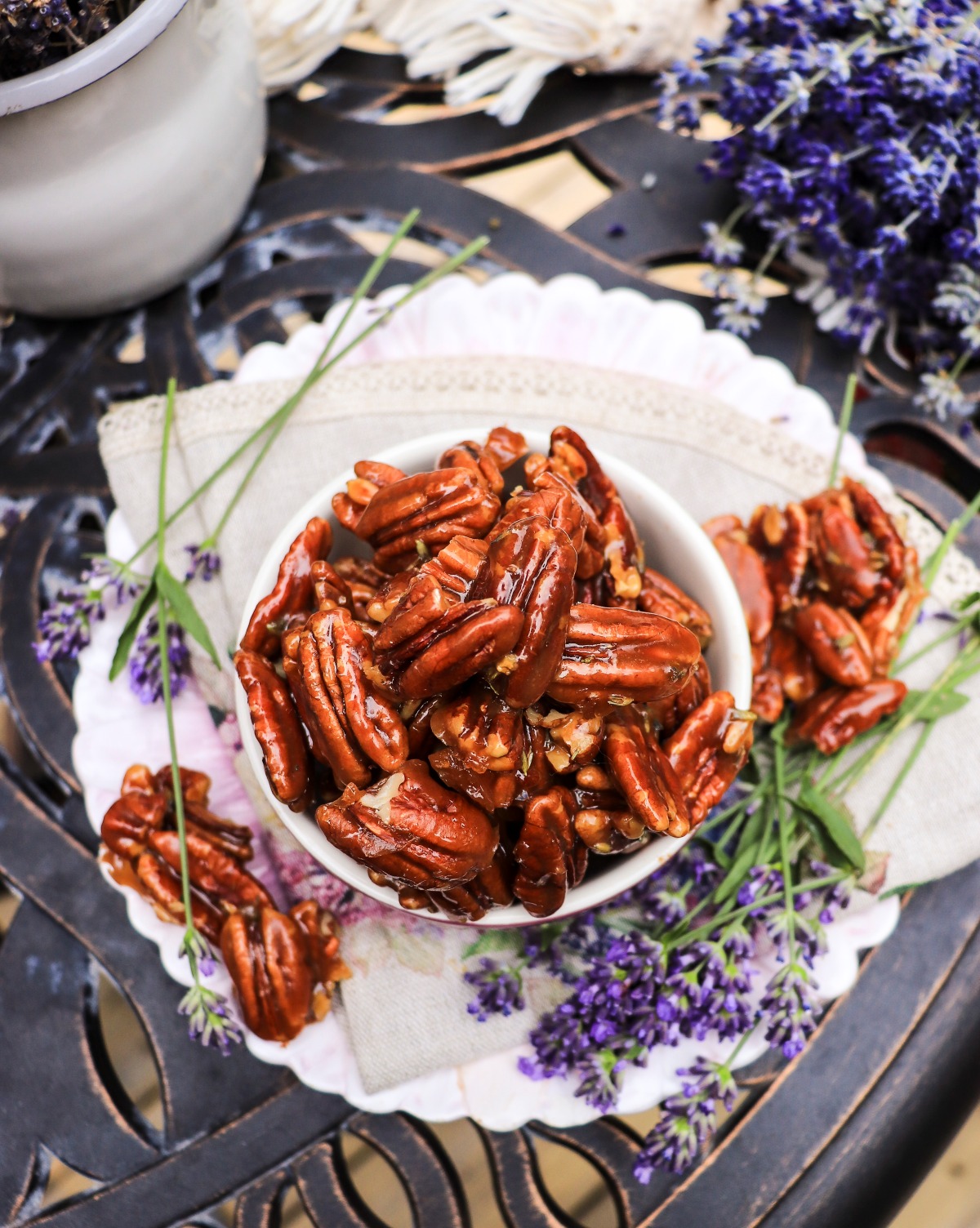
There are many ways to make caramelized pecans, but this version is all about a simplified cooking method and balanced flavours. Honey creates a rich glaze, while lavender transforms familiar honey candied pecans with a delicate aromatic note.
Honey Caramelized Pecans with Lavender: A Quick and Simplified Stovetop Method
One of the best things about these stovetop caramelized pecans with honey and lavender is how quickly they come together. There is no oven to preheat and no lengthy baking or repeated stirring.
Instead, almost everything happens in one skillet. First, you toast the pecans for just 2–3 minutes and transfer them to a bowl. Then, you use the same pan to prepare the honey-butter mixture before returning the nuts and coating them.
Besides being quicker, this simplified stovetop method gives you direct control over the caramelization. You can adjust the heat as soon as the syrup starts bubbling too vigorously or thickening faster than expected.
As a result, these skillet honey candied pecans are particularly convenient when you want a small homemade treat without committing to a traditional oven method.
Honey Creates a Rich, Glossy Coating In These Lavender Caramelized Pecans
While sugar provides structure and caramel notes, honey gives these lavender honey candied pecans their distinctive character. It adds a more complex sweetness and helps create a smooth, glossy coating when combined with butter.
Light brown sugar gives the caramelized pecans familiar caramel and subtle molasses notes. Alternatively, maple sugar adds a delicate maple undertone that works beautifully with both honey and pecans.
Butter adds richness and contributes to the softer glaze. Therefore, don’t expect the thick, dry sugar crust associated with some classic candied pecan recipes. These honey and caramelized pecans with lavender have a rich caramelized coating surrounding their naturally crunchy centres.
Honey and Lavender Are a Natural Pairing
Honey and lavender work particularly well together because honey already has naturally floral characteristics. A small amount of culinary lavender enhances those notes instead of introducing an entirely separate flavour.
However, restraint is important. Culinary lavender can vary considerably in strength, and too much can quickly overwhelm both honey and pecans.
For 400 grams of pecans, I suggest starting with 1/4 teaspoon of finely rubbed culinary lavender. This gives the honey caramelized pecans a subtle floral background. You can increase the amount towards 1/2 teaspoon if your lavender is mild or you prefer a more pronounced floral aroma.
Brief Toasting Intensifies the Pecan Flavour
Although the pecans will spend a little more time in the skillet once coated, I still recommend giving them a brief dry toast first.
Just 2–3 minutes over moderate heat enhances their naturally buttery, nutty flavour. This is particularly useful for honey candied pecans because it keeps the pecan flavour prominent underneath the sweet coating.
And because you toast the nuts directly in the skillet used for the rest of the recipe, this extra step doesn’t create additional cleanup.
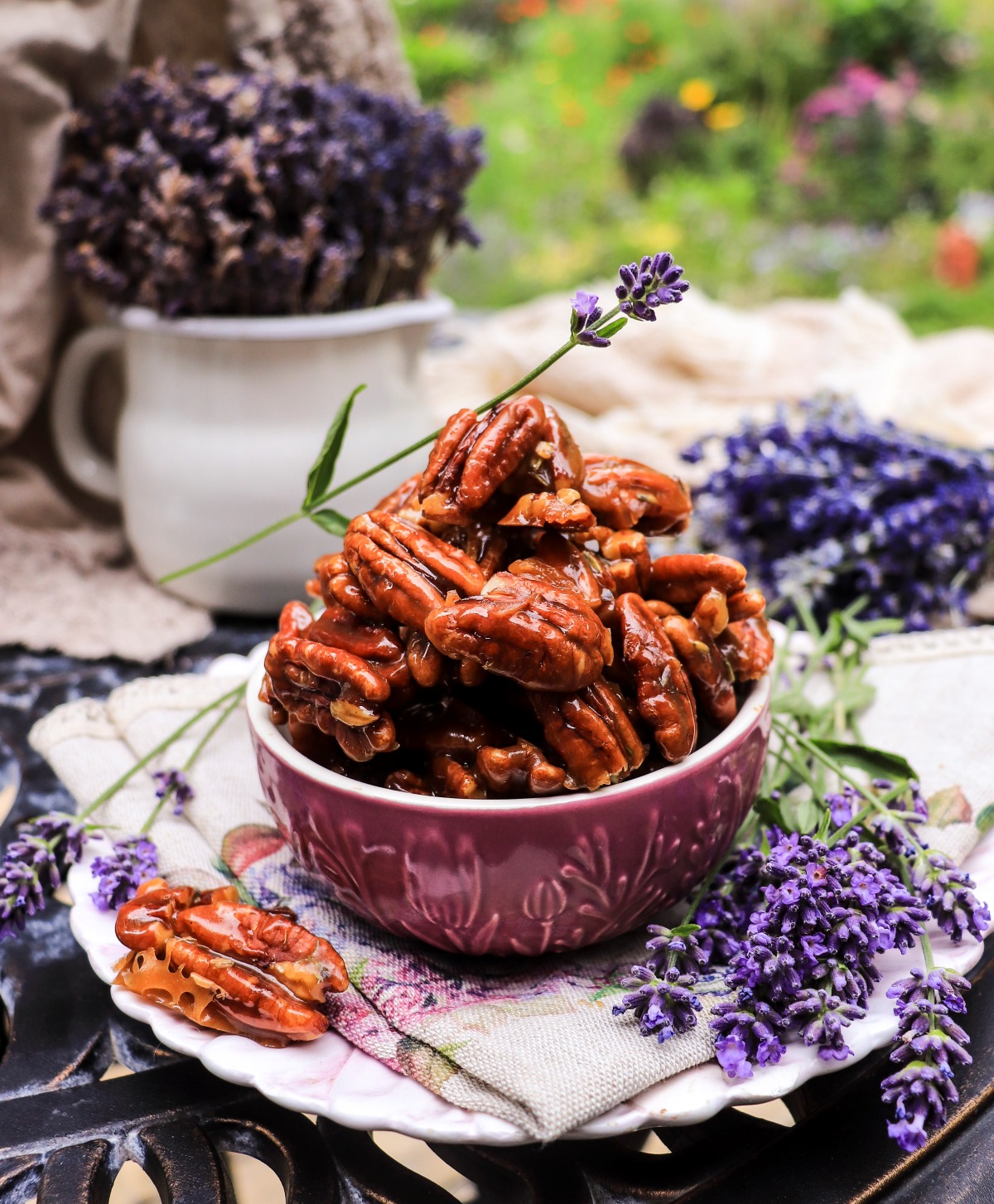
Ingredients You’ll Need for Lavender Honey Caramelized Pecans
You only need six ingredients for these honey caramelized pecans with lavender. Because the ingredient list is so short, each one has an important role in the flavour and texture.
- Pecans – You will need about 400 grams of pecan halves. Briefly toasting them before adding the honey glaze enhances their rich, nutty flavour.
- Butter – About 75–80 grams adds richness and helps create the smooth caramelized coating.
- Honey – Honey is the primary liquid sweetener in these honey candied pecans. Besides sweetness, it contributes flavour and a glossy texture.
- Light brown or maple sugar – Light brown sugar adds familiar caramel and molasses notes. Maple sugar is a lovely alternative for a subtle maple undertone.
- Culinary lavender – Use about 1/4–1/2 teaspoon depending on its potency and your preferred floral intensity. Rub it between your fingers before adding it to release more aroma.
- Salt – A small pinch balances the sweetness and accentuates both the honey and toasted pecans.
Light Brown or Maple Sugar?
Both light brown sugar and maple sugar work beautifully in these honey caramelized pecans with lavender, but they give the coating a slightly different character. Here’s what to consider:
- Light brown sugar – The more classic and readily available option. It adds gentle molasses and caramel notes and gives the pecans a familiar, rich candied flavour.
- Maple sugar – Adds warm, earthy maple notes and may taste slightly less sweet than light brown sugar. Its more nuanced flavour pairs particularly well with pecans, honey, and lavender.
- Which one to choose? – Use light brown sugar for a more traditional caramelized pecan profile. Choose maple sugar for a slightly less sweet impression and a subtle maple twist. Either works well in this stovetop recipe.
How to Make Honey Caramelized Pecans with Lavender
It’s easy and quick to make these stovetop caramelized pecans with honey and lavender. Start by adding the pecans to a large dry skillet. Toast them over low-medium heat for about 2–3 minutes, tossing frequently, just until they become fragrant. Don’t let them darken too much. Transfer the toasted pecans to a bowl and set them aside.
Add the butter, honey, light brown or maple sugar, salt, and rubbed lavender to the same skillet. Cook over medium heat for about 1–2 minutes, stirring until the butter has melted and the mixture is smooth. Then, reduce the heat and continue cooking gently for about 5 minutes. The mixture should bubble steadily and gradually become slightly thicker and glossier.
Return the toasted pecans to the skillet and toss until evenly coated. Transfer the honey and lavender caramelized pecans promptly to parchment paper and spread them out while the coating is still hot. Allow the stovetop candied pecans to cool completely before serving or storing.
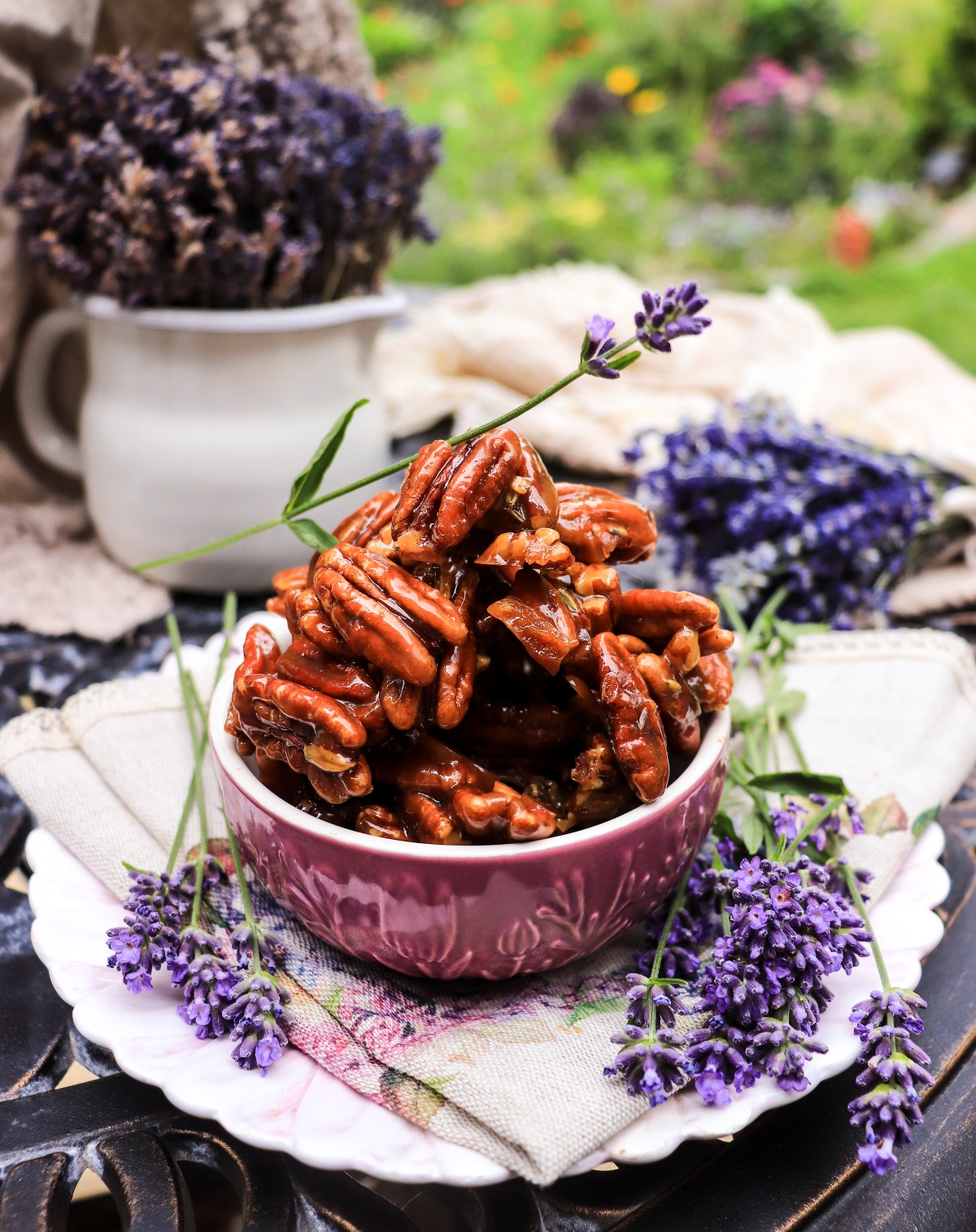
Tips for Perfect Stovetop Candied Pecans with Honey and Lavender
Making stovetop candied pecans with honey and lavender is quite straightforward, but honey and sugar react quickly to changes in temperature. Paying attention to your pan, heat, and syrup is therefore more important than following the cooking time to the second.
Choose a Heavy-Bottomed Pan
A heavy-bottomed skillet is particularly useful for stovetop honey caramelized pecans because it distributes heat more evenly. A thin pan can develop hot spots, causing one part of the honey-sugar mixture to scorch while another part is still relatively thin.
Also, choose a skillet wide enough to accommodate all 400 grams of pecans comfortably. You need enough room to toss the nuts through the caramelized mixture rather than having them piled on top of one another.
A wide, heavy skillet also makes it easier to judge the consistency of the syrup as it cooks.
Adjust the Heat as the Syrup Cooks
Don’t rely exclusively on the heat setting given in the recipe. Stoves, burners, and pans behave differently, so the appearance and behaviour of the syrup are more useful indicators.
Start around medium heat so the butter melts and the honey, sugar, and butter come together efficiently. Once the mixture is smooth and bubbling, reduce the heat. During the remaining cooking time, you want controlled, steady bubbling rather than an aggressive boil.
If the syrup bubbles extremely rapidly or begins darkening around the edges, lower the heat further. Conversely, if there is almost no bubbling, increase the temperature slightly.
This gradual adjustment is one of the advantages of making skillet candied pecans: you can respond immediately to what is happening in the pan.
Watch the Syrup, Not Just the Clock
The suggested cooking time is a guide rather than an absolute rule. When making honey candied pecans, visual and aromatic cues can tell you considerably more than the timer.
Look for the following signs:
- Gentle bubbling – The mixture should simmer steadily rather than boil aggressively.
- Glossiness – The butter, honey, and sugar should form a smooth, shiny syrup.
- Slight thickening – The coating should become somewhat more viscous but remain fluid enough to coat the pecans easily.
- Darkening around the edges – This can indicate that your heat is too high.
- Burnt or bitter aroma – Remove the pan from the heat immediately if the syrup starts smelling scorched.
Unlike a classic caramel made with white sugar, you aren’t looking for a dramatic deep amber colour. Honey and light brown or maple sugar already contribute colour, so it can be difficult to judge caramelization by colour alone.
Don’t Overcook the Honey Mixture
The coating on these stovetop candied pecans continues to thicken as it cools. Therefore, the syrup should still look relatively fluid when you return the toasted pecans to the skillet.
If you wait until the honey mixture looks extremely thick in the pan, it may become overly hard or sticky after cooling. It will also be more difficult to distribute evenly over the nuts.
When in doubt, err slightly on the side of less cooking. The residual heat and cooling process will continue changing the consistency of the caramelized coating.
Work Quickly Once the Pecans Are Coated
Once the pecans are thoroughly coated, remove them from the skillet promptly. Spread the honey glazed pecans over parchment paper and separate any particularly large clusters while the coating remains warm and pliable.
As the caramelized mixture cools, the nuts will become increasingly difficult to separate without breaking them. However, you don’t need to separate every pecan individually. A few small clusters are part of the appeal of homemade candied pecans.
Clean the Pan Before the Caramel Hardens
Caramel cleanup is much easier if you deal with the pan shortly after making the stovetop caramelized pecans. Once you have safely transferred the nuts, fill the pan with hot water and let it soak. Because sugar dissolves in water, much of the residue should loosen without aggressive scrubbing.
For more stubborn residue, these methods can help:
- Hot water – Cover the hardened caramel with water and bring it to a gentle boil. Often, this alone is enough to dissolve the sugar.
- Baking soda – For stubborn cooked-on residue, a little baking soda can be added to the water. Be careful because the mixture may foam as it heats.
- Lemon – A little lemon juice added to the water is another option for loosening stubborn sugar residue, provided it is suitable for your cookware.
- Soaking – If necessary, turn off the heat and leave the pan to soak until the remaining caramel softens.
- Gentle cleaning – Avoid aggressively scraping hardened caramel, particularly from non-stick or other coated pans.
Once the caramel has softened or dissolved, allow the pan to cool sufficiently before washing it normally.
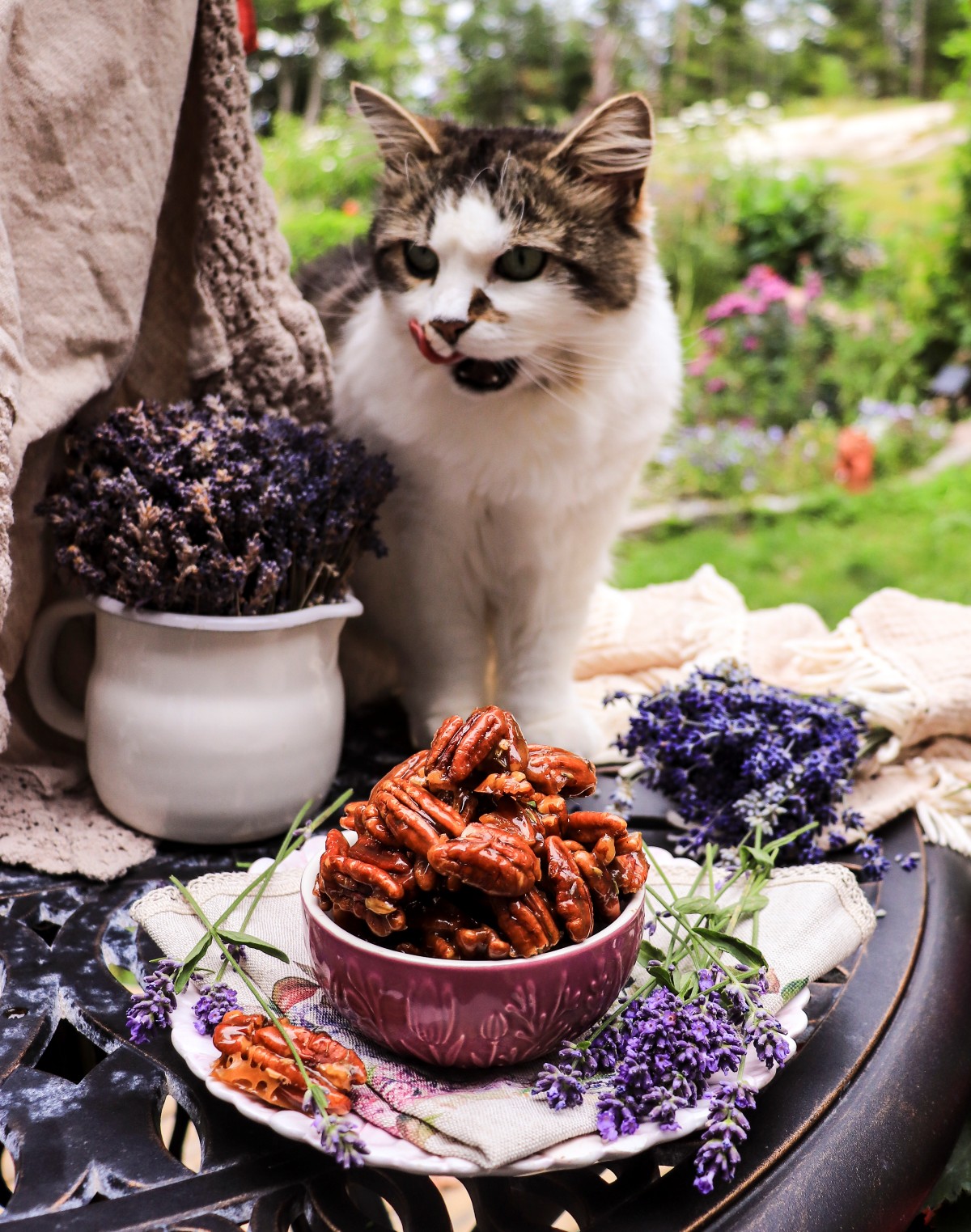
Storage and Make Ahead
Allow the honey caramelized pecans with lavender to cool completely before transferring them to an airtight container. Sealing warm candied pecans can trap condensation and soften their coating.
Store them in a cool, dry place away from humidity. For the best flavour and crunch, I recommend enjoying these honey candied pecans within several days. After that, the caramelized coating may gradually become softer and stickier, particularly during hot or humid weather. They will still be delicious, but the texture will be at its best during the first few days.
More Caramelized Nuts Recipes You May Like
If you enjoy homemade caramelized nuts, like these honey caramelized pecans with lavender, here are a few more sweet and savoury ideas to try:
- Maple Candied Nuts with Lavender – Easy Stovetop Sweet Snack
- Savoury Caramelized Cashews with Maple and Lavender
- Frosted Maple Candied Almonds – Easy Stovetop Recipe
- Dulce de Leche Candied Pecans – Easy Stovetop Recipe
- Candied Pine Nuts – Easy Stovetop Recipe
- Maple Candied Pecans – Easy One-Pan Stovetop Recipe
- Maple Candied Cashews – Easy Stovetop Caramelized Nuts
- Stovetop Gingerbread Candied Nuts – A Festive Stovetop Recipe
- Festive Toffee Orange Brandy Pecans – Easy Stovetop Recipe for the Holidays
I’d love for you to try this recipe for stovetop caramelized pecans with honey and lavender. If you give it a go, please share your results in the comments, message me on Instagram, or post your photos with the hashtag #havocinthekitchen. I look forward to seeing your creations and hearing your thoughts.
Cheers!
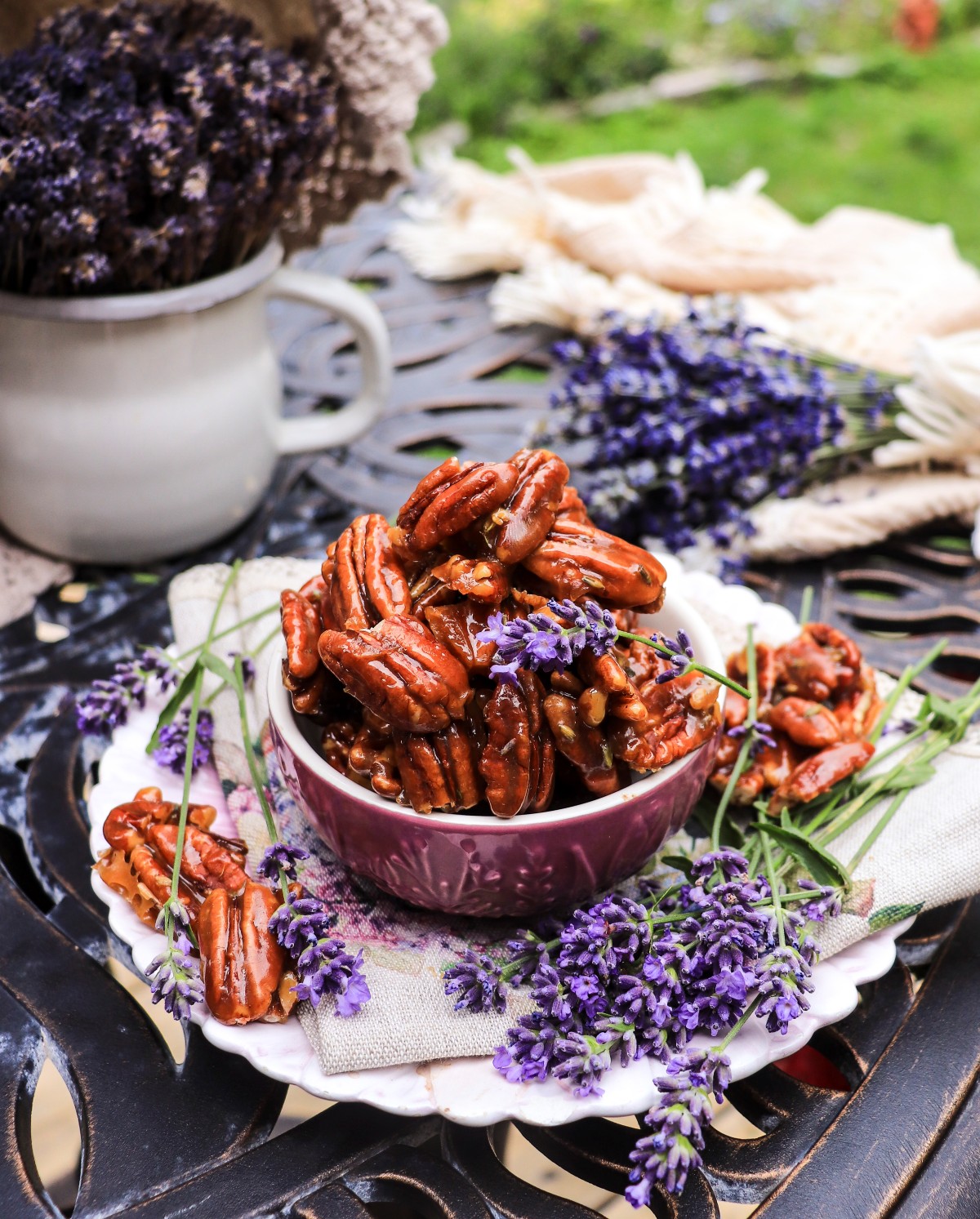
Honey Caramelized Pecans with Lavender
These honey caramelized pecans with lavender are toasted, buttery, and coated in a rich honey glaze with a subtle floral aroma. These easy stovetop candied pecans come together quickly without an oven.